Posts

Showing posts with the label Online Marketing Manager | Richard Hartigan | Online Marketing

Conference Season

The beginning of Q4 is the time when most e-commerce organisations are finalising plans for the important Christmas trading period, January 2011 and beyond. Therefore it is no coincidence that a number of suppliers and agencies concentrate on this period to acquire new leads. This push for new business manifests itself in an increase in cold calls and a flurry of conferences over this period.

With a number of conferences available, it is always difficult to identify the best ones and quantity the return on investment. Prices usually range from between £300 and £1,000 but price is not always proportional to value; some of the best conferences I have attended have been free. Every conference features sessions with enticing descriptions from big name brands and agencies. The titles of these sessions usually capture current trending buzzwords but this is very often deceptive. One speaker recently admitted during their session on "monetizing social media" that the title was just to get people in the door.

It surprises me that speakers and sessions are not subject to the very reviews and social scrutiny that are very often discussing. This would surely help to increase the standard of presentations and help attendees and prospective attendees decide whether the session is worth attending.

This year, I was fortunate enough to attend two conferences in October. For anyone that is interested in attending conferences next year, I shall weigh up the pro's and con's of both below.

AFU Expo - Excel, London - 12th Oct
Cost - £495

The A4U Expo is a an Affiliate Marketing Conference aimed at merchants, networks and affiliates but the breadth of topics covered make it a worthwhile conference for anyone working in online marketing. 

At any conference, attendees will always enjoy the session thsat resonates with their own challenges. The most valuable session of this year was Helen Southgate, Senior Online Marketing Manager at SKY. 

Advantages

+ Networking. The networking opportunities are extremely good. Although most affiliates are London centric, there are others that rarely venture down South. I usually capitalise on this to meet with a number of key suppliers and affiliates within the same few days.

+ Layout. Once you eventually get to the Excel Conference center (see disadvantages below) the layout was great and has been improved upon from previous years by moving to the West side of the Excel Exhibition centre. the rooms had considerable space

+ Party! The parties associated with A4U have always been really good events. This year the A4U organising committee put on a pre-party, a party on the first night and a closing party. I only attended the first night party but these are always promise to be late affairs and the smell of alcohol is dominant throughout the second days lectures.

Disadvantages

- Transport. The Excel is one of the most challenging venues to get to in London. For most people it takes a minimum of three modes of transport to get there. The 0900 start time for the conference means that it is an early start for most people.

- Layout. This year saw the introduction of a live conference area which was placed in the middle of the exhibition hall. This area played host to some very interesting speakers but it was too distracting to listen to them above the general noise. Particularly as there was a popular driving simulator situated directly behind the stage.

- Repetition. Like the affiliate industry in general, there is not much in terms of a fresh new content or presenters. Brilliant though some of them are, on the whole it is the same individuals presenting and the same subjects covered.  
  
I have attended this conference for the past three years now and it has become progressively less value to me. Potentially this is as my career has progressed and I am now interested in different challenges. There is no doubt that the A4UExpo has been of value to me over the past three years. It has allowed me to graduate from an affiliate novice to a confident practicioner. I would recommend it to anyone who wants to increase their affiliate knowledge but this was probably my last year.


JUMP - Old Billingsgate, London - 13th Oct
Cost - £875
This conference was aimed at capitalising on the current positive sentiment towards multichannel marketing. It was organised by econsultancy and featured 8 rooms of speakers.

Advantages

+ Content. At any conference it is always important to try and distinguish the valuable sessions from their cryptic titles. I made some mistakes at JUMP but on the whole the content was of a great quality. The sessions from Matthew Tod from Logan Tod on Actionable Analytics and Rowan Gormley the CEO and founder of Naked Wines on founding a truly social business were the highlight for me.

+ Attendees. The event managed to attract a huge number of high profile marketers from some of the most noted online brands in the UK. Therefore I think it would have been valuable to have some round table sessions. Although the panel sessions were extremely well moderated, the time pressure meant that there were a number of questions that remained unanswered.

+ Location. Old Billingsgate is a great venue to hold a conference. Londoners can easily access the venue from a number of different tube stations and it's also not far away from London Bridge, Fenchurch St or Liverpool St station.  


Disadvantages

- Crowds. The morning sessions in particular were very overcrowded. On numerous occasions I was turned away from a session as they were too busy. There was the facility to prebook some of the sessions online but this made matters even more complicated as the staff had no way to distinguish and prioritise the individuals that had prebooked.

- Cost. I was fortunate enough to receive a ticket for free but the door price for this one day event was £895. Given the above I would have been extremely disappointed to have paid the full price fee and not have the opportunity to see the sessions I wanted.

- Venue. This was the first conference I have attended at Old Billingsgate and I was less than impressed with the suitability of the venue. Firstly, the door staff would not allow anyone into the exhibition area prior to the event opening at 0900. This led to a number of attendees half queuing, half loitering  outside. Secondly, the seminar rooms were not big enough and clearly not designed for this purpose. It was distracting to hear the sound overlapping between the different rooms, which were sometimes only segregated by a curtain.

This was a mixed first year for JUMP. There were some obvious learnings that have already been acknowledged in a email from Ashley Friedlein, CEO of Econsultancy. I am sure that Jump 2011 will be an excellent event.


Email Fail

I received the below email from Flybe before embarking upon a recent trip. The email kindly wishes me a good trip, reminds me of my booking details and invites me to check in for my flight online.

The intention is great, despite the fact that it invites everyone to check in online, so securing the best seat becomes a scramble for who can open their email fastest.

However they have made a huge mistake within the design of the email. The large red arrow that contains the call to action to check in online is not hyperlinked.


One of the greatest strengths of online marketing is the ability to deeplink customers into further within a site. This could be to a stage within a purchase or registration process or to a page that contains the relevant content. In this instance any deeplink should land me at a minimum on a page that allows me to log in to the early check-in process.

Unfortunately, it looks as if Flybe have missed an element of the design that is essential to delivering the great customer experience they are intending.

e-Lection 2010


After the US presidential election of 2008, I blogged about the importance of new media in political campaigning and how the number of inbound links to a website could give a good indication as to the swing of the voters. It's no secret that Barack Obama dominated John McCain in terms of online marketing effectiveness and this was demonstrated by the fact his website amassed over double the amount of inbound links of his Republican competitor.

This is the first real UK election of the new media age so it is interesting to conduct the same analysis into the online marketing activity of each party. Whilst other pundits have focused on social media, I thought I would look specifically at the holistic search strategy of each party.


Labour.org.uk

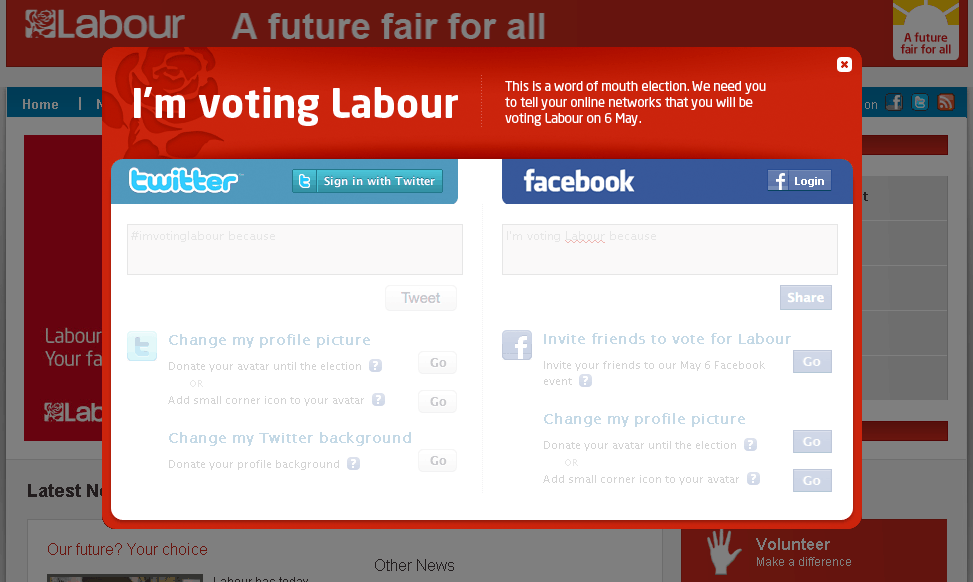
The website for the incumbent party is a simple site that integrates a number of social media elements such as Flickr photos of Gordon Brown and links to Youtube videos of the manifesto and public addresses.

As soon as the website opens, a pop-up is triggered, inviting the user to tell their friends and followers from Facebook and Twitter that they are voting Labour. Despite this being perhaps a bit of a presumptious move and degrading to the user experience, it is not search engine friendly. We know from Adwords editorial guidelines that Google is not keen on pop-ups and can assume the same applies to SEO.

From an SEO perspective, the title and meta tags are all different and reasonably well structured, although there is some inconsistency as you progress further into the site. The site has an unclassified Google PageRank*, meaning that it has been created or redesigned recently, before Google updated their toolbar with the latest update.

It is also interesting to note that Labour have not devoted much attention to paid search, When searching for "Labour Party" in Google, the top result features the title "Labour have Failed". Labour are not bidding on their own brand name or at a minimum protecting it from being used in rivals titles and descriptions which means that rivals can easily enter and manipulate this space.

It is also interesting to note that Labour have not covered themselves in glory on the paid search front. Searching "Labour Party" in Google results in the following SERP. It appears that Labour are not even bidding on their own brand name, allowing rivals to easily enter and manipulate this space.


Conservatives.com

The conservative party is the only one of the big three to use a dot com domain, which is generally more recognisable to the average user. The site itself is very similar to the Labour site but there is a lot more content and a lot less social media elements which in my opinion, are overused on the Labour site.

Searching for "Conservatives" in Google shows the correct website in the number one position in the natural results with no paid search results above it. However a search for "Conservative Party" features a strongly worded anti-blood sport result in the top sponsored result. Like their Labour rivals, the Tories have neglected paid search when building their online strategy.

The website is fortunate enough to feature sitelinks and a site search box on the Google results page, which enables users to use the Google search algorithm to locate relevant parts of their site. 


Titles and descriptions are well organised and consistent and there is a lot of content throughout the site. However, of the three main sites, the Tories have attracted the fewest number of inbound links, indicating a lack of SEO strategy or ineffective online PR that builds interest in the site. As a result, the displayed PageRank for the conservative website is 6.


Libdems.org.uk

The Libdems have used a different format for their site design. It is a bit more colourful and cluttered than those of it's competitors. The Libdems do occasionally show a splash page to their users that arrive from different sources. Whilst showing specific landing pages per source is a good thing, it is not best practice to show these instead of the home page.

These splash pages all have different URL's, little content and no meta or title information which could affect how the overall website is displayed within the search engines. The site itself also has little consistency when it comes to titles and descriptions.

It is interesting to note that the Libdems site has 328,366 inbound links, which is more than Labour and the Tories put together. As a result the Libdems also have the highest visible PageRank of the main three parties with 7.

From a paid search perspective, the Libdems face less aggression than the other parties. They maintain the number one position for the majority of their branded terms and also feature sitelinks below their main listing. Like their competitors, the Libdems do not appear to be conducting any paid search activity which is potentially a missed opportunity.

---

It is reasonable to conclude that despite the best intentions to embrace online marketing and some real innovation in the social media space, none of the main political parties have delivered an effective search marketing strategy. This is a big missing. Google have released their own interface that allows users to track the performance of different aspects of the election. It is clear that search volume is heavily influenced by the televised debates and campaign highlights or lowlights in the case of Bigot-gate. It is clear to see that a lot of people are searching on both party leaders and names and the main issues involved Indeed, even if I ask Google who I should vote for, no party competes for my vote.

*PageRank described is the value displayed in the Google toolbar, not actual PageRank.

G-Force

I read with interest reports from NMA of Google moving into the price comparison space for financial products with Google Comparison Ads. This product has been floating around for a while in the US under the guise of Google Merchant Search but the site of comparison functionality under a search for "secured loans" represents the first sighting in the UK.

The threat of Google increasingly moving into this space must be the cause of many sleepless nights for online comparison websites such as Shopzilla, Kelkoo and Shopping.com. These organisations have built their businesses around a consumer desire for simple online product comparison. The majority of their revenue comes from turning cheap clicks acquired from search engines, into more expensive clicks and sales for advertisers paid on a CPC/CPA rate.

Google have continually denied any desire to move into the price comparison space. A number of years ago, I challenged them on the rumours of a travel price comparison site named Troogle, a new rival to TravelSupermarket and Cheapflights. Although this was categorically denied by Google, the main reason the rumours continue to circulate is that there remains a gap in the market for an all powerful meta comparison engine. I also know some Google staff have made it their life's goal to ensure that purchasing travel online is made so much easier.

In my opinion, one of the main reasons that Google is so reluctant to state any explicit intent to expand into the price comparison space, is the conflict between their desire to innovate and the effect this may have on their cash cow.

Despite continual diversification into new and innovative products and the majority of Google's revenue is still obtained from their original Adwords product. Price comparison sites are traditionally significant spenders in PPC. In the UK, MoneySupermarket is renowned as Google's largest single account. It is also the largest price comparison site.

MoneySupermarket will typically feature and compare the products of many leading brands that also pay to advertise within the Google sponsored listings. Without doubt the competition between direct and indirect advertisers is a major contributor the Google revenue figure (and also one of my personal frustrations).

Whilst Google may see it as desirable for the user experience to combat the additional layer that is the price comparison site and give more value to direct advertisers, there is clearly a risk from the reduced number of advertisers bidding for the top positions.

By creating price comparison functionality within the search engine results pages, Google threatens to bite the very hand that feeds them. They will earn some incremental revenue from the increased clicks from the direct brands that advertise with them directly but I question whether this will compensate for the investment that will lose by marginalising the comparison engines.

I can't help but wonder how this will develop. Comparison Ads infiltrating the UK SERPS, Google Shopping maturing and growing and an increases desire from Google to ensure that they are the first port of call for any activity that takes place online.

HTC Hero

Is this the first realistic threat to the iPhone?


Skimming

The company Skimlinks was a big winner at the recent A4U awards winning Best Use of Technology, Best New Entrant and Innovative Publisher of the Year.

They work by allowing publishers to monetize their content by analysing it for potential to include affiliate links. For example, if I wrote a blog post about Nike trainers with a link to JJB Sports to purchase, Skimlinks would be able to find that link, recognise the link to JJB Sports and replace it with an affiliate link. As a publisher, I would now be earning revenue from what was previously a simple link on my website.

In content text linking is very much a silent participant in the online marketing world. Organisations such as Kontera and Infolinks are rarely discussed and seldom found in any top end content sites. Their value to the customer experience is questionable and publishers fail to make significant revenue from the cost per click model in place.

Therefore, it is easy to see why Skimlinks is appreciated by affiliates and publishers alike. They allow further monetisation of content by using the traditional CPA model.

What about Advertisers?

It is easy to see how Skimlinks is a fantastic tool for publishers, but does the innovative technology add positive value to advertisers?

Skimming is a generally regarded as a derogatory term. Although Pond Skimming is an excellent past time, the word is more commonly associated with Credit Card fraud. I would question whether Skimlinks is the best name for an organisation given the reservations about affiliate marketing still inherent within many e-commerce operations.

I have worked on both sides of the fence when it comes to an organisational attitude to affiliates; where affiliates are regarded as costly intermediaries and more and where they are embraced as a key driver of incremental sales. I know a number of directors that would object to me proposing that we work with an organisation called Skimlinks.

The ability to make incremental sales is a fair challenge to put to Skimlinks. It could well be argued that because the publisher already had links to the advertiser, they would have received the sale anyway. Skimlinks purely rewards the publisher for sales they are generating, even those they are unaware of.

Whether these reservations will define the success of Skimlinks or not, it is good to see innovation within the affiliate space. With the current dominance of comparison, coupons and cashback the affiliate marketing industry has a vested interest in protecting the large proportion of content affiliates that are missing out on last click attributed sales. I applaud Skimlinks attempts to reward content sites that add value to the customer journey but are increasingly getting less share of the overall bounty.

Doing Bird

The explosion of Twitter as a social network has been astonishing during 2009 as the micro-blogging mechanism has made the leap from the online niche to the mainstream. It would seem that Stephen Fry getting stuck in a lift was the best thing that could ever happen to newest Silicon Valley start-up in Feb 2009.


So how are businesses engaging in this new tool? O2 UK picked up on some tweets from celebrity Phillip Schofield who was having some problems with his iPhone. Using Twitter, O2 were able to guide Mr. Schofield through the necessary steps in order to resolve his problem. This looked great for O2. The problem was that all these conversations took place in the public domain so all of Schofield's followers, that were O2 customers quickly got in touch to find out about new tariffs, handsets and whether there was a new iPhone arriving in the Spring. The Official O2 Twitter account had essentially become an interface for customers to speak to the brand. As a result, the poor fellow that manages the O2 Twitter account, quickly found that his remit expanded to cover PR, Customer Service, retention and acquisition and O2 had to rapidly rethink how they used Twitter.

Other businesses have encountered problems with how they embrace Twitter as well. Mars offered Twitter users the chance to have their tweets featured on the Skittles home page if they mentioned the word skittles within their tweet. Cue the British public using the depths of the English language in order to crowbar as many profanities as possible onto home page of the brands home page.

Recently, Twitter was even instrumental in the end an a-list celebrity relationship as poor John Mayer's excuse that he was too busy with work to reply to
girlfriend Jenifer Aniston's text messages, were exposed as he was found to have updated his twitter profile numerous times during the same period.

So there you have it, a new craze is out there. Twitter is the tool of 2009 and organisations that feel they should be harnessing the power of social media as part of their online marketing strategy are swarming to it trying to do something, anything to prove they are web 2.0 savvy. It will be exciting to see what brands
will do next. One thing is for sure, there will be more disasters than there will successes before the tool and users find the optimum position for both to benefit.

and if you're reading this Jen, I'd give up twitter for you.

When Targeting Technology Goes Wrong

Increased targeting is one of the benefits most frequently associated with Online Marketing. The ability to use technology to target niche segments is considered a major advantage of the medium as it uses data to segment and identify key segments far more efficiently and quickly than a human ever could. However, using technology to target customers does not come without complications.

In one of my previous roles, I used Google content targeting to sell flights and holiday packages to European and Worldwide destinations. One day our PR team received a complaint from a distressed widow claiming that we were advertising our fantastic holidays on a memorial website adjacent to the written tributes for her recently deceased husband. His name was Mr. Madeira.


Google content network had obviously identified the content on the memorial website as relevant to the keywords within our campaign and shown what it deemed to be an appropriate advert within the adsense unit on the page.

Now in my opinion, Mrs. Madeira had every right to vent her fury at our company for displaying an advert on this page. I do believe however that her anger was misdirected. If I ran a memorial website, I would not look to have advertising on it unless I was specifically in responsible for the content that is there. I simply would not trust a content network that displays inventory algorithmically to place adverts that would be appropriate to my highly sensitive audience. The risk of upsetting my customer base would be too great.


Brands should always understand that the Internet is a very big place and that whatever targeting technology they implement, there is always a chance of upsetting minorities of the Internet population. Anyone who is involved in using technology to target and segment audiences understands this. Unfortunately, only a small percentage of the online population fit into this category.

The Best Marketing Campaign of 2009...to date.

This month there has been a lot of coverage about a particular job working for Tourism Queensland in Australia as a caretaker for Islands of the Great Barrier Reef.

The job involves sampling all the activities the island has to offer, including a new luxury spa, snorkeling and bush walking and reporting back via an online video diary with associated blog.

It is being described as the Best Job in the World and comes with a luxury house on the beach, and a salary of approximately £55K for the six months contract.

As part of the interview process, 11 candidates will be flown out to Australia where they will be subjected to 'rigorous' tests. These will involve scuba diving and sailing as well as sampling local cuisine and culture. (Where's the psychometric testing?!?)

Now anyone would think this is an amazing opportunity. The cynics however may
wonder as to why Tourism Queensland is prepared to invest so heavily in what is, in essence, a paid holiday. Well it is in fact a superbly delivered marketing campaign to promote tourism to the destination.

The job managed to gain coverage across every major news channel on both TV and radio, there were articles in every paper & topical news website and the viral effect resulted in the deeplink being passed around the internet quicker than a celebrity sex video.

In a time where we wake each morning to news of a businesses in financial trouble and economic doom and gloom this positive news stood out from any broadcast and within any publication.

The site managed to gain over 1M visits in the space of three days, causing the servers to fail under the strain. The site was also redesigned to
facilitate better merchandising of Tourism Queensland and incentivised visitors to join it's RSS feed or email updates in order to win prizes.

The demand was unprecedented. The cost of all this coverage was £55K + overheads for six months. I am sure a number of major brands would really struggle to get the same kind of exposure even if they had ten times the budget.

This year marketers are going to have to use their budgets in innovative ways as return on marketing investment is scrutinised even more in challenging times. It is not about marketing less, it's about marketing smarter. In my view, Tourism Queensland have set the bar for 2009. I'm excited to see what happens next.